The CFD tab solves the gas flowing through the grain port and the nozzle, and the air around the rocket in 3-D with its fins, at one instant of the burn. Recorded with a Personal license on the solid rocket example: port flow and the vehicle’s CFD need a license.
Narrated walkthrough, 1:58, recorded in RPL Engine Workbench 2.0 with a Personal license. MP4, 6.4 MB.Transcript
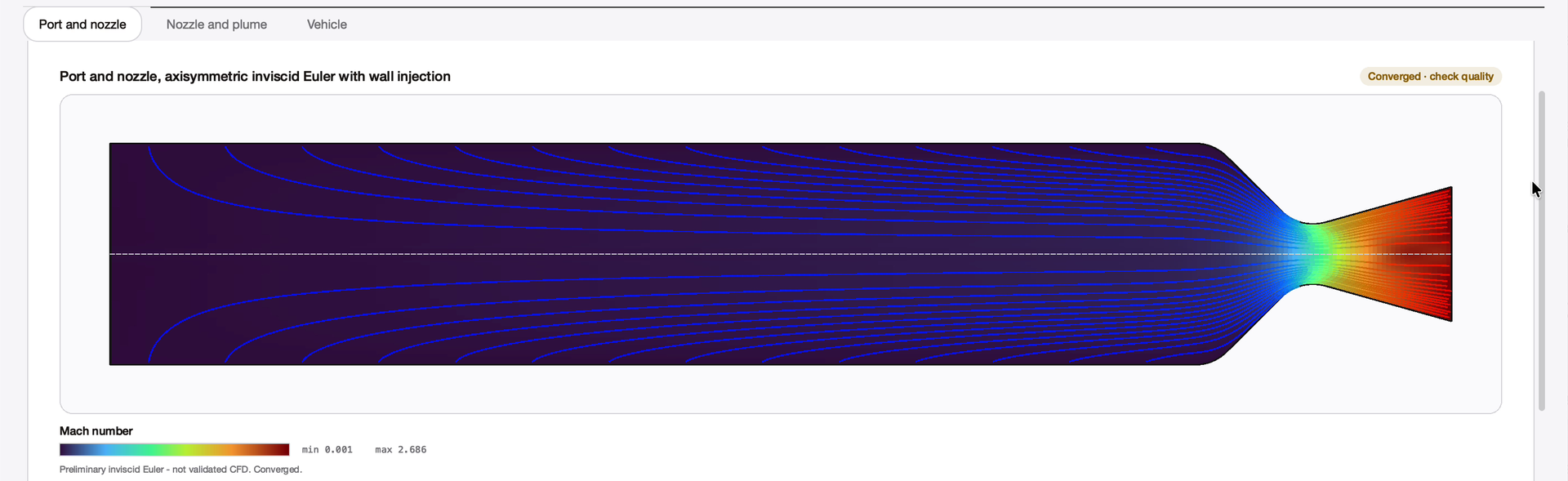
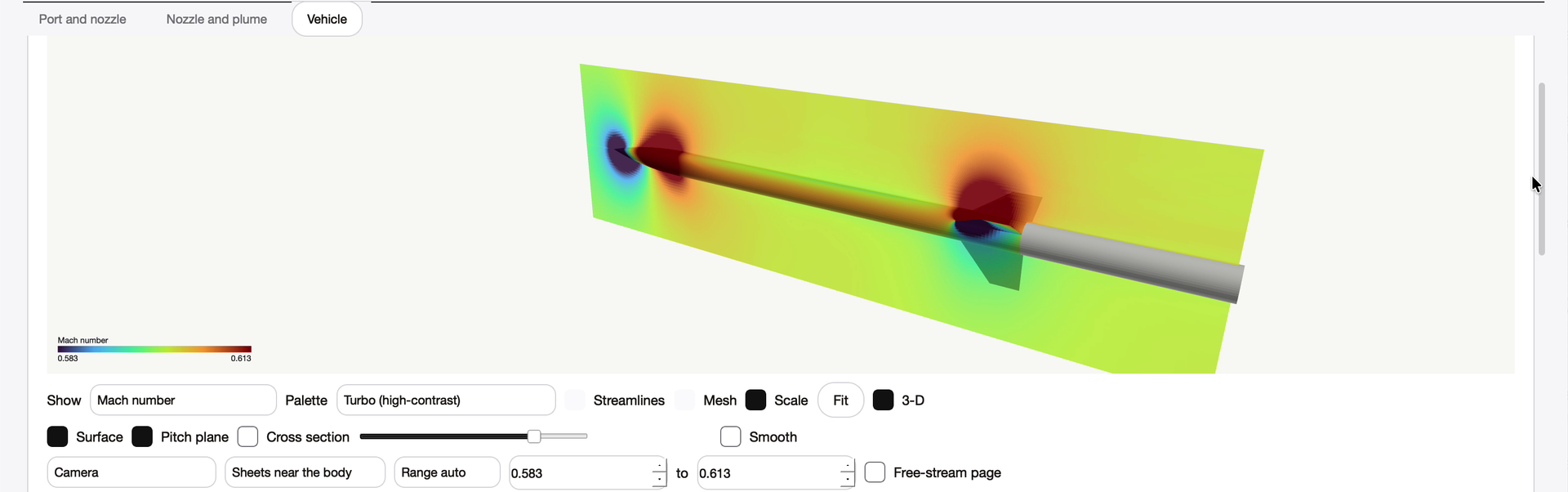
This tutorial covers the CFD in version 2.0: the flow inside the motor, and the air around the rocket. Port flow and vehicle CFD require a license. Here, we're running on a Personal license. The CFD tab works at one instant of the burn. Peak pressure selects 0.97 seconds, at 512.7 psi. Port and Nozzle models the flow inside the motor. Solve port flow at this instant. Gas enters through the burning walls of the grain and exits through the nozzle. Here, the solve takes less than half a minute. The head-end pressure comes out at 513.7 psi, compared to 512.7 from the burn curve. The outlet passes 0.6072 lb/s, against 0.6082 produced by the grain. Mach number and streamlines show the gas moving slowly along the port, reaching just 0.077, before accelerating through the throat. The result is labeled preliminary inviscid CFD, along with its convergence status. On the Vehicle page, we can solve the airflow around the same rocket. Either the body alone, or in three dimensions with its fins. Choose 3-D with fins, using the inviscid model. The motor's exhaust jet can also be included at the base. For this run, it's disabled, and the base sits on a sting. Set Mach 0.6, and an angle of attack of 4 degrees. Then press Solve. This mesh contains just over one million cells. The simulation took about five minutes on this Mac, converging after 2,222 iterations. In three dimensions, the colors represent Mach number across the rocket's surface, and through the angle-of-attack plane. Flow is slower at the nose tip, and accelerates over the nose shoulder and around the fins. The results provide normal force and pitching moment, placing the center of pressure 37.66 inches from the nose. Every run identifies its model, mesh, and convergence status. Mach number and angle-of-attack sweeps can also be used in the flight simulation.
Steps
Solve the motor. Open File → Open Example → Solid rocket and press Solve. The CFD pages work on the solved burn.
Pick the burn instant. On the CFD tab, Burn instant sets the moment the pages solve; the dashed line on the Review charts marks it. Peak pressure picks 0.971 s, at 512.7 psi chamber pressure.
Solve the port flow. On Port and nozzle, press Solve port flow at this instant. It solves the gas entering through the burning wall of the grain and leaving through the nozzle, axisymmetric and inviscid, in under half a minute here. The head-end pressure comes out at 513.7 psi against 512.7 psi from the burn curve, the highest Mach number in the port is 0.077, and the outlet passes 0.6072 of the 0.6082 lb/s the grain gives off (8,000 cells, converged after 10,123 iterations).
Mach number and streamlines in the port and nozzle at peak pressure.
Solve the rocket in 3-D. On Vehicle, choose 3-D with fins, inviscid, set Mach 0.60 and 4° angle of attack, and press Solve. With Motor jet off the base sits on a sting; with it on, the motor’s jet is part of the flow. At Standard resolution this run used 1,088,000 cells and converged after 2,222 iterations in about five and a half minutes on an Apple silicon Mac.
Read the result. Turn on 3-D and press Fit to see Mach number on the surface and in the pitch plane. The result line gives the normal-force coefficient (1.1794), the pitching moment about the centre of gravity at lift-off, and the centre of pressure, 37.66 in from the nose, with the forces on the body, base and fins listed by part.
Mach number on the surface and in the pitch plane: 3-D inviscid with the fins, 1,088,000 cells, converged.
Fly with it. Mach and angle sweep solves a table the flight can use: tick Fly with the 3-D CFD table on this page.
Before you rely on a number
These are preliminary inviscid results from the example’s inputs, labelled so in the app; inviscid flow gives no skin friction. Each run states its mesh and whether it converged, and a run that does not converge says so: on a coarse mesh, or near Mach 1, a solve can stop before it converges, and its numbers should not be used. Check anything you build against test data and an independent review. Methods and assumptions lists the models.